

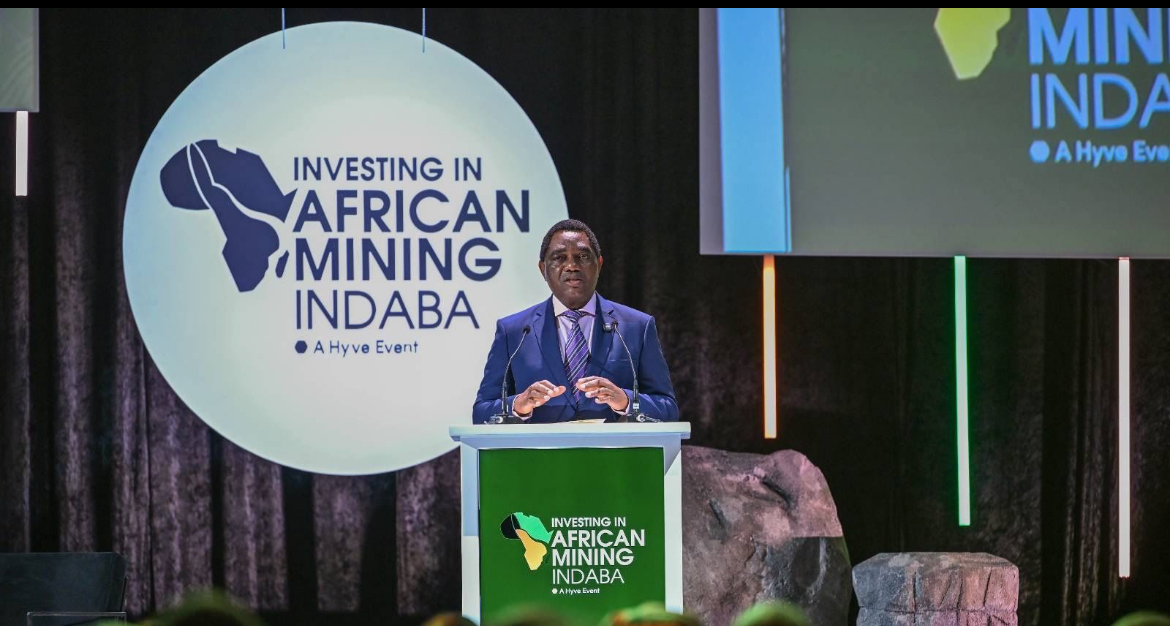
At the 2026 Mining Indaba in Cape Town, President Hakainde Hichilema of Zambia delivered a message centred on unity, inclusion and shared prosperity, positioning the mining sector as both a driver of economic resilience and a symbol of broader continental collaboration. Speaking to a diverse gathering of industry leaders, investors and policymakers, the Zambian head of state emphasised that Africa’s future lies not in competition but in complementarity, noting that prosperity will only be achieved through cooperation at all levels of the economic value chain.
Reflecting on his journey since first attending the Indaba as a newly elected president in 2022, President Hichilema stated that the annual forum continues to represent the collective ambitions of African nations to harness their resource wealth for meaningful transformation. His remarks came amid Zambia’s remarkable economic recovery, with GDP growth projected at 6.4 percent in 2026, a significant rebound from the contraction of minus 2.8 percent prior to his administration. Inflation, too, has begun to stabilise, following targeted economic reforms.
Central to the president’s address was the argument that resource-based growth must deliver tangible dividends for ordinary citizens, not only for corporations and governments. He cited the case of Konkola Copper Mines, a key mining operation that was placed in liquidation prior to his administration. Under his leadership, the mine has resumed production, an outcome he described as a turning point that reinforces investor confidence and operational continuity.



President Hichilema linked mining revenues to social outcomes, highlighting a government-led initiative that has facilitated the return of 2.3 million children to school. This development, according to the president, is emblematic of how extractive industries can support broad-based development when managed with transparency and inclusion. The mining sector, he argued, cannot operate in isolation from contractors, suppliers or communities. “We are one economy. We must work together,” he remarked, urging a departure from extractive models that separate economic actors and instead encouraging integrative strategies.
The president’s remarks took on a broader geopolitical tone as he noted the changing global landscape, asserting that the world is increasingly framed by divisions. However, he encouraged African nations to remain steadfast in their unity. “Whilst I see that we are together, we are one team,” he said, reflecting a vision that goes beyond national boundaries and speaks to continental solidarity.

As global conversations around the energy transition continue, President Hichilema underscored Africa’s crucial role in supplying the minerals essential for clean energy technologies. He called upon investors and partners to recognise Africa not merely as a source of raw materials but as a region capable of contributing strategically to global sustainability. In doing so, he challenged prevailing narratives that often relegate African states to the margins of global innovation.
In an era of shifting alliances and evolving economic dynamics, the Zambian president presented a vision that was neither insular nor overly idealistic. Rather, it was grounded in the recognition that inclusive participation and local ownership offer long-term stability and accountability. He concluded with a statement that encapsulated his administration’s approach: inclusion fosters investment, and investment serves as an insurance policy against negative behaviour.
President Hichilema’s intervention at the Indaba not only reaffirmed Zambia’s renewed economic outlook but also positioned the country as a constructive voice within a pan African dialogue. By advancing a narrative that humanises development and centres the African experience, his message offered a counterpoint to linear models of growth and demonstrated a commitment to reshaping how African agency is understood in the global economy.


