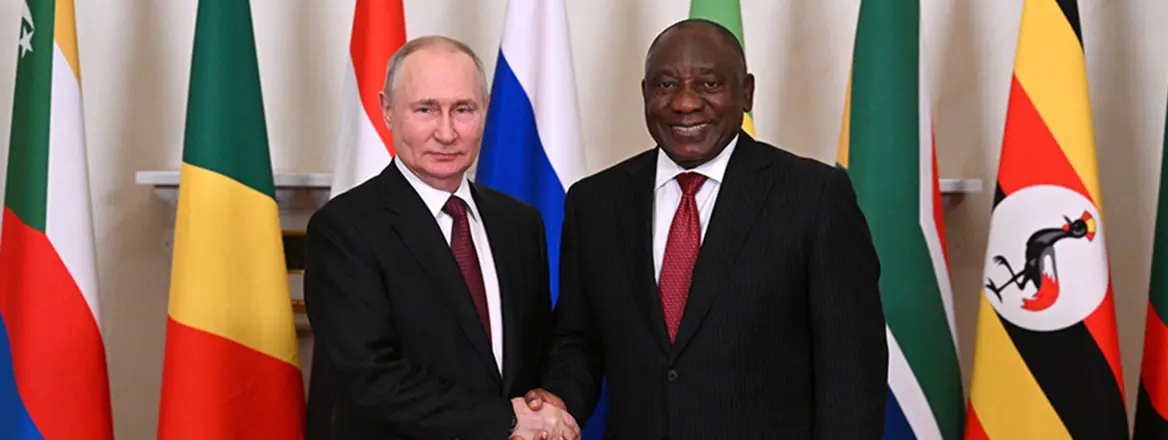
South African President Cyril Ramaphosa has reiterated the nation’s longstanding alliance with Russia, referring to the country as a “valued ally” during a bilateral meeting with Russian President Vladimir Putin on Tuesday. The meeting, held on the eve of the BRICS summit in the Russian city of Kazan, highlights South Africa’s continued diplomatic and economic ties with Moscow, even as global tensions persist over Russia’s invasion of Ukraine.
In remarks shared by South Africa’s government news agency on social media, Ramaphosa praised Russia’s historical support for South Africa, noting the enduring nature of their relationship. “We continue to see Russia as a valued ally, as a valued friend who supported us right from the beginning, from the days of our struggle against apartheid,” said Ramaphosa. This reference to Russia’s solidarity during South Africa’s anti-apartheid movement is a common theme in Pretoria’s diplomatic discourse, serving as a foundation for the modern ties between the two nations.
As the BRICS summit convenes in Kazan, discussions among the member states—Brazil, Russia, India, China, and South Africa—are expected to cover a range of critical issues, including economic cooperation, the de-dollarisation of trade, and strategies to bolster multilateralism in a shifting global order. Ramaphosa underscored the importance of these meetings, stating, “We are going to have important discussions here in Kazan within the BRICS family.”




South Africa’s diplomatic stance regarding Russia has drawn considerable attention, particularly from Western nations. Pretoria has maintained a position of neutrality over the Ukraine conflict, choosing not to condemn Russia’s military actions directly and focusing instead on calls for dialogue and diplomatic resolution. Despite the criticism, South Africa’s government continues to emphasise its commitment to a balanced foreign policy, engaging with both Western powers and nations like Russia that form part of its historical alliances.
The close ties between South Africa and Russia, reinforced by frequent bilateral exchanges, have been met with scrutiny, particularly in light of recent international developments. South Africa’s decision earlier this year to abstain from enforcing the International Criminal Court’s (ICC) arrest warrant for Putin, citing constitutional and diplomatic concerns, created a significant rift with Western allies. Nonetheless, Pretoria has remained steadfast in its approach, stressing the importance of sovereignty and non-alignment in global conflicts.
Russia’s role in the upcoming summit further cements its importance within the BRICS bloc, especially as it seeks to counterbalance Western sanctions and expand its influence across the Global South. For South Africa, this summit represents not only an opportunity to deepen its ties with Russia but also to solidify its role as a key player within BRICS. The group, which seeks to reform global financial institutions and promote a more multipolar world order, is expected to advance discussions on creating alternative trade networks and currency systems that challenge Western dominance.

As South Africa continues to navigate its complex diplomatic landscape, balancing relations with both Russia and Western nations will remain a critical task. With Ramaphosa’s public reaffirmation of Russia as a “valued ally,” the Kazan summit is likely to further illustrate the country’s geopolitical positioning within the emerging multipolar world.