

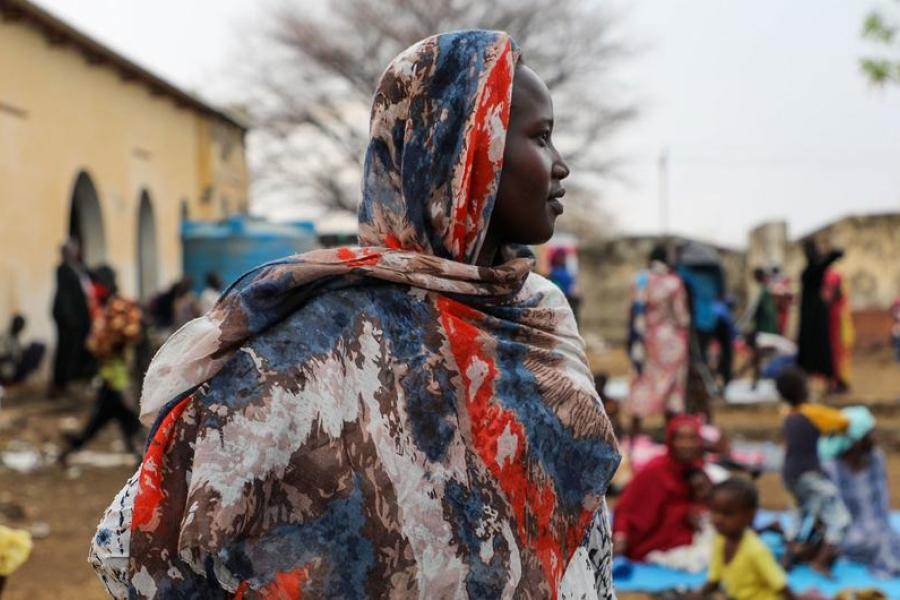
When a power struggle between Sudan’s rival military leaders shattered a tenuous peace in her village in Sudan’s western region of Darfur, Halime Yacoub Issac’s first instinct was to take her five children and run.
But four days after seeking refuge in neighbouring Chad – a country with its own dire humanitarian crisis – she had yet to receive any assistance and was just hoping they wouldn’t starve.
“We’re entirely dependent on food Chadian families give us,” Issac told Reuters, sitting in a rare patch of shade near the border village of Goungour with other newly arrived women and children, some of them orphans.
Nearby, hundreds of families were camped out under trees or had built flimsy shelters out of sticks and bedsheets that swayed in the wind.
The battles between the Sudanese army and the paramilitary Rapid Support Forces that erupted in the capital Khartoum in mid-April have now engulfed large parts of Sudan, killing hundreds, wounding thousands and unleashing a humanitarian disaster that could not have come at a worse time.
Africa was already facing a deepening set of crises – from drought to floods and a growing list of armed conflicts – that has seen demand surge for life-saving humanitarian assistance.
Now, according to an internal U.N. estimate obtained by Reuters, 5 million additional people in Sudan will require emergency assistance, half of them children.
By October, some 860,000 people are expected to flee to neighbouring countries including Chad, placing additional strain on nations already facing some of the world’s most under-funded humanitarian crises.
Yet a Reuters analysis of United Nations funding data for Africa shows financial support from key donor governments is dropping off.
Securing additional money is a long shot, 12 aid workers, diplomats and donor government officials told Reuters. More likely, they said, funding gaps will grow as Europe focuses on Ukraine, post-Brexit Britain turns inward, and some lawmakers in the United States, the world’s largest donor, target budget cuts.
“There is going to be less funding this year,” the World Food Programme’s (WFP) new executive director, Cindy McCain, told Reuters during a visit to Somalia this month. “I pray that there won’t be. But the reality of it is that there is going to be less.”
Every day, hundreds of Sudanese trek across the desert scrubland and dry riverbeds that make up large sections of the country’s 1,400-km (870-mile) border with Chad. Some 30,000 have arrived so far, according to the U.N. refugee agency UNHCR, which expects it will need to establish five new camps to accommodate them.
Aid agencies are rushing to distribute emergency food and register new arrivals, but resources are tight. Even before the latest crisis, U.N. humanitarian appeals for Africa faced a $17-billion funding gap this year, risking leaving millions without lifesaving assistance.
Desperation is growing among the refugees. Chadian soldiers used whips on Sunday to beat back dozens of women who had started grabbing bags of provisions in Koufroune, another border village, when they saw that supplies brought by a Turkish aid group were running out.
“You’ve got this huge arc of misery across this part of Africa, and Sudan is just the latest crisis to be added to that in humanitarian terms,” Andrew Mitchell, Britain’s minister of state for development and Africa, said during a trip to Kenya this month.
DONORS PULL BACK
Between 2020 and this year, Africa’s needs reflected in U.N. appeals grew nearly 27%. But as wealthy countries began looking inward to shield their citizens from the COVID-19 pandemic, many cut back on humanitarian activities abroad.
Britain, for example, announced in 2021 it would temporarily reduce its aid budget to 0.5% of gross national income from 0.7% to pay for the pandemic response. Last year, it spent a third of its overseas aid budget housing refugees inside the UK, a British aid watchdog said in March.
“There’s no question that very large amounts of money have been lost,” Mitchell said, asked about Britain’s aid budget.
Between 2020, when the UK was the third-biggest contributor to U.N. humanitarian appeals in Africa, and 2022, its contribution dropped by 55%. Mitchell declined to say how much the UK would contribute for 2023.
Funding for U.N. appeals does not reflect all donor money for Africa, but relief agencies and government officials say it is indicative of broader contribution trends.
Britain isn’t an outlier – and Russia’s invasion of Ukraine last year has accelerated the exodus, humanitarian officials say.
Between 2021 and 2022, the continent’s humanitarian needs rose by nearly 13%. But leading donors, including Canada, Sweden, Japan, Norway, and the Netherlands, all scaled back funding for Africa, the U.N. data showed.
The United States has in recent years stepped in to fill gaps. Washington nearly doubled its contribution for the U.N.’s Africa appeals between 2020 and 2022. Last year, it provided nearly $6.4 billion, or over 56% of all funding.
That looks set to change, however.
Most of Washington’s added support has come via supplemental budget appropriations from Congress, initially for pandemic relief and last year to mitigate fallout from the Ukraine war.
But U.S. lawmakers are now embroiled in a fight over the debt ceiling, with many Republicans focused on cutting budgets, not expanding them.
“With this Congress, it’s unlikely there will be more supplemental funding,” said one U.S. official involved in humanitarian response, who was not authorised to speak to the media.
Without it, overall U.S. humanitarian spending will fall by nearly 20% to $10.5 billion in 2023, with a further decline to $8.5 billion next year.
The White House did not immediately respond to a request for comment.
For aid agencies, that’s meant belt-tightening.
WFP has cut rations in Nigeria, Central African Republic, Burkina Faso, Cameroon, Mali, Mauritania and Niger. Without additional financing, the agency told Reuters, it will halt all assistance for over 700,000 refugees and internally displaced people in Chad this month.
Sudan was hosting over 1 million refugees, mainly from South Sudan, Eritrea, Ethiopia and Syria, before the outbreak of fighting last month. A third of Sudan’s own 46 million citizens also relied on aid, according to the U.N.
But the lack of funding has forced WFP to cut back on nutrition interventions for mothers and young children since last year. Now, the violence has brought some humanitarian operations to a standstill. Aid workers have been killed, food aid looted, and WFP says it’s running out of stocks.
UNHCR is appealing for an additional half billion dollars for Sudan. But the U.N.’s joint appeal for the country – a request for $1.75 billion that predates the latest violence – is only 15% funded.
“I’ve been briefing our donors constantly since day one,” said one international aid official, who asked not to be named for fear of antagonising benefactors. “They all say it’s great that you’re committed to helping the Sudanese people, but it stops there.”
‘CATASTROPHICALLY UNDERFUNDED’
Humanitarian agencies are rushing to reallocate resources to Sudan fallout. With record numbers of Africans already going hungry, it’s a zero-sum game.
Aid workers off-loaded jugs of cooking oil and sacks of grain onto the dusty ground in eastern Chad last week, as crowds of Sudanese refugees waited patiently nearby.
But that food had been earmarked to help needy Chadians make it to the next harvest and will need to be replenished. Just 4.6% of Chad’s own U.N. appeal has been financed this year.
WFP says it has scraped together enough provisions to support 20,000 new refugees for one month, but it’s expecting five times that number.
Food prices in local markets are sky-rocketing due to demand from refugees, and malnutrition admissions at health centres have spiked.
“It’s an extra strain on the entire Chadian population,” said Pierre Honnorat, the WFP director in Chad. “It’s becoming very, very hard.”
A similar scenario is playing out in South Sudan, where some 35,000 people have arrived from Sudan. Most are South Sudanese who fled north to escape their own country’s violence.
“We left our homes in South Sudan. We left our homes in Sudan. We’ve left our homes everywhere to come sit in a desert like this,” said Suzan William, who had been working as a nurse in Khartoum when the fighting broke out and was waiting for food near the border.
Elsewhere in Africa, other disasters, including a looming famine in Somalia, are also vying for money.
Concerned about support from traditional donors, aid agencies are courting new sources – notably Gulf States – but they are struggling.
“I’m really worried for 2023, honestly,” Jan Egeland, head of the Norwegian Refugee Council, told reporters.
“The only fully funded operation in the world now is in Ukraine. All other operations are catastrophically underfunded.”





