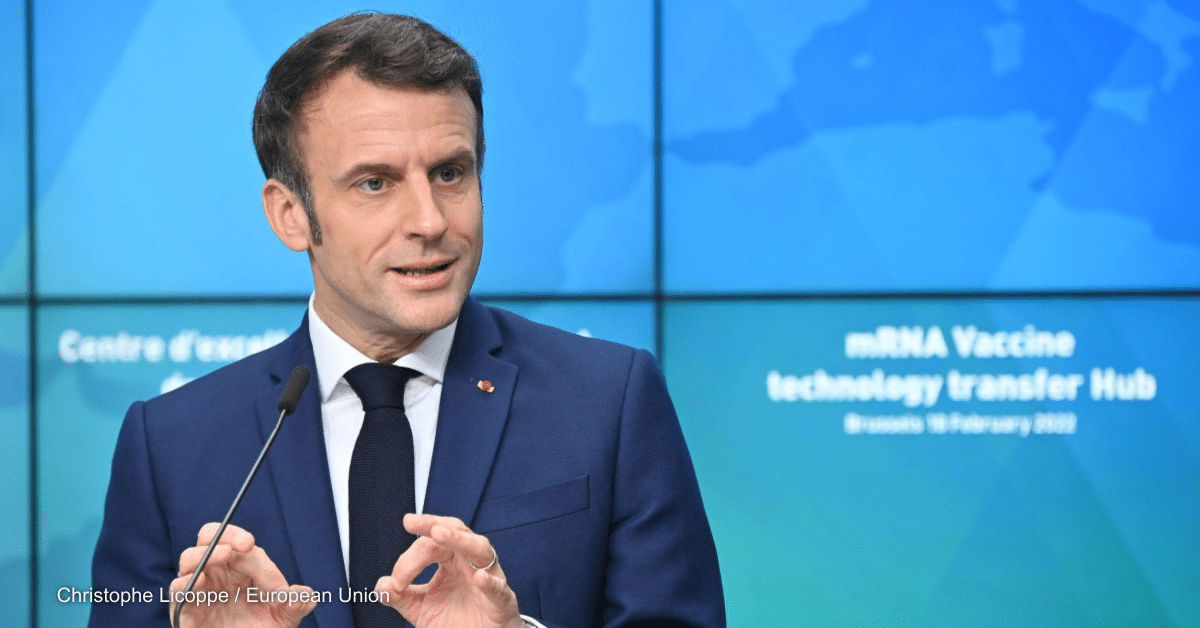
It took one sentence in the wee hours of Friday morning for Emmanuel Macron to put more than seven years of work by the European Commission and others in mortal jeopardy.
Asked at a press conference whether it was time to ditch the fledgling, ailing, and still-unsigned Post-Cotonou Agreement between the European Union and the 79-member Organisation of African, Caribbean and Pacific States, or OACPS, the French president appeared open to it.
“You are right to underline the difficulty,” Macron said after Devex cited Hungary’s two-year blocking of the agreement and South Africa’s recent decision to quit OACPS as evidence that the text risks being dead on arrival. “I share your point. I think that certain frameworks are a bit worn out today and so we must go beyond.”



It was classic Macron. A former diplomatic sherpa, renowned for his grasp of complex and obscure issues, he knew the weight his words would carry. However, by couching his response alongside a general call to reboot north-south relations and a plug for a global financing summit in Paris this June, he left enough ambiguity to allow the commission and OACPS to claim he was not aiming at Post-Cotonou.
“President’s Macron’s response is not calling for putting aside the Post-Cotonou Agreement,” OACPS spokesperson Sousa Jamba told Devex by email Friday. “This is an agreement which came about because times had changed, and there was a need to restructure the relationship between Europe and the OACPS.”
“The Commission has negotiated the Post Cotonou in line with the Council mandate and we expect the Council to allow its signature,” a European Commission spokesperson told Devex, referring to the EU body representing its member states.
If OACPS and the commission thought they were not in Macron’s crosshairs though, Tomas Tobé, the center-right Swedish member of the European Parliament who chairs the body’s development committee, certainly did.
“This is very concerning,” Tobé told Devex Friday in response to Macron’s comments. “Our partner countries expect us to deliver on our promise and proceed with the signature of the new agreement.”
Regardless, Macron’s words marked a dramatic plot twist.
The official line from the commission and pro-OACPS officials from EU member states for weeks has been that there is ‘no plan B, only plan A’ when it comes to Post-Cotonou — i.e., get Hungary to sign in order to end the embarrassing prospect of a possible fourth extension to the 2000 Cotonou Agreement, which, among other things, gives the European Investment Bank its mandate to lend in ACP countries.
But when given the chance to use his significant star power Friday to help get the deal done, Macron did the opposite. And in doing so, he nudged what was once a stalwart of EU development cooperation closer to the abyss.
A death foretold
The 187-page Post-Cotonou agreement touches on almost everything from fisheries to connectivity to human rights to statistics to “inclusive and pluralistic societies.” But unlike its predecessor, it has no role in determining the allocation of the European Commission’s foreign aid.

That meant that when Hungary refused to sign the text finalized by the commission and OACPS on the grounds that it was too generous on legal migration to Europe, there was little impetus to force its hand. Instead, Post-Cotonou entered suspended animation: Finally initialed in April 2021 after years of sometimes rancorous talks between the commission and OACPS, but lacking the backing of all the EU states required to see it provisionally applied.
“I struggle to see any significant issue — economic, political, migration — … where post-Cotonou is really needed to go forward,” San Bilal, a senior executive at the European Center for Development Policy Management think tank, told Devex Friday in response to Macron’s comments. “I’ve never heard over the last few years a reference to post-Cotonou beyond self-contained post-Cotonou discussions about its negotiations, value-added and ratification. Concerns of a Brussels bubble about an old framework which ‘doesn’t want to die’, though pretty useless.”
Not all EU member states had wanted a successor to Cotonou in the first place, questioning its added value and the logic of trying to engage 79 very different countries — albeit with three regional protocols — under one agreement. Still, the commission began negotiations in September 2018, with the argument that the EU-OACPS relationship could help shore up voting blocks at the United Nations, for instance. That logic is now looking increasingly shaky, after the mixed global response to Russia’s invasion of Ukraine, as well as China’s win over France’s candidate to lead the U.N. Food and Agriculture Organization in 2019.
OACPS includes countries from Ethiopia to Tonga, and Niels Keijzer, a researcher at the German Institute of Development and Sustainability, told Devex that when combined with the EU, the pair are “too large and heterogenous to meaningfully cooperate in international fora and negotiations.”
Meanwhile, the EU has focused its political charm offensive in recent years on the African Union, culminating in a key summit in February 2022 where the EU and AU agreed on a joint vision statement and European leaders pledged to leverage €150 billion (about $182 billion) for the continent by 2027.
OACPS maintains a roughly 50-person secretariat in Brussels, working on climate change and private sector development and co-funded to the tune of €6.5 million by the commission in 2020. But the secretariat played only a cameo role at last year’s EU-AU summit and was not consulted at all when the commission announced a new “alliance” with Africa in September 2018. Spending €4 million of EU taxpayer money on an office renovation that will now likely never happen — as revealed by Devex in December — did not help the OACPS brand either.

Anything but usé
All of the above meant that Post-Cotonou’s star was fading well before last week’s summit of EU leaders, which ironically was designed to agree on stricter measures to curb irregular migration. The commission is adamant that the Post-Cotonou text is much more useful than its predecessor in this regard, with an annex on return and readmission processes for failed migrants. However, the commission spokesperson confirmed that “the Post Cotonou agreement was not discussed at the European Council.”
Instead, on Friday the commission got a kick in the teeth — or at least the shins — from their favorite ally. Germany might give roughly twice as much official development assistance as France, but Macron’s brio on the international scene and penchant for calling summits on biodiversity, financing African economies, and this summer’s new pact with the global south mean that he more than any other leader sets Brussels’ development agenda.
Now, there was a disturbance in the force. As recently as November, commission President Ursula von der Leyen defended the Post-Cotonou Agreement, telling journalists that “it’s always worth to invest strength and time into relationships that have been established, whether they go through difficult times or whether we are in good times”.
With Macron, in response to Devex’s question on Post-Cotonou Friday, calling the existing development framework “worn down” — or “not fit for purpose” depending on one’s translation of the French “usé” — the commission continued to defend the agreement.
“[Post-Cotonou] contains common views on values, a common vision on policy priorities and even clear operational elements on things [such] as return and readmission,” the spokesperson wrote to Devex. “We do not consider it ‘usé’, quite the contrary. We look forward to continuing discussions on how international financial institutions can further facilitate funding for development at the June Summit, hosted by President Macron. But it goes without saying that this summit cannot replace many elements the Post Cotonou framework offers.”
Macronology
While the commission and ACP fought back, however, others welcomed Macron’s candor.
“I’m not surprised by Macron’s statement. He just articulated publicly what many are quietly discussing,” a former member of the OACPS Committee of Ambassadors told Devex. “The separation of the financial package from the new ACP/EU Agreement which allows delivery even in the absence of signature of the Agreement has lessened considerably the need for signature.”
“The Caribbean and Pacific have neither done [n]or said anything to convey concern about the way in which the OACPS/EU relationship has declined to the point of inertia,” the source added. “I expect the Brussels OACPS institutions will attempt to push back against Macron but they are unlikely to gain traction. The relevant DG in the Commission will also try to defend its turf but how strongly I’m not sure.”
On the commission side, a former official who helped craft the Post-Cotonou deal told Devex that Macron’s comments “make sense.” Neither the EU nor OACPS had applied sufficient pressure to unblock the agreement and had failed to contextualize it as a tool for region-to-region and multilateral cooperation, the former official said.
“I feel the moment existing before the pandemic etc. is lost,” they added, with the last ACP-EU Council of Ministers in November 2022, “as usual, a non-event.”
“Now we have a lit match in hand,” the ex-official said, and the EU “as usual, will be criticized whatever it will do.”