The 26th United Nations Climate Change Conference of the Parties (COP26) has brought together all the relevant stakeholders around the world to mitigate climate change.
Scientists have established that human-induced climate change is fueled largely by energy production and consumption – data from the International Energy Agency (IEA) suggest that the energy sector contributes three quarters of the world’s entire greenhouse gas emissions. This means that the energy sector is the critical point in the fight against climate change.
To mitigate climate change, the world will have to transform the production, transportation and consumption of energy, moving away from dirty energy sources such as fossil fuel to renewable energy which is clean and safe for the environment. Admittedly, this goal cannot be attained without the full commitment of China and the United States, the world’s two largest economies which also happen to be the two largest emitters of greenhouse gases.



While available evidence suggests a looming crisis if appropriate and timely measures are not carried out to address climate change, the question on everyone’s mind is – are China and the U.S. pulling their weight?
Sadly, over the years, the level of dedication demonstrated by these two countries to mitigate climate change is unfair as China’s efforts far exceed those of the United States, which at one point even withdrew from the Paris Climate Agreement.
China on the other hand, has consistently exhibited a strong commitment to achieve the goals of the Paris Climate Agreement and the United Nations Framework Convention on Climate Change as the country is focused on allocating adequate resources to transform the production and consumption of energy – by spearheading renewable energy infrastructure development projects around the globe, China is on track in protecting the environment and concurrently creating sustainable renewable energy jobs, which is essential in facilitating the global transition to clean energy.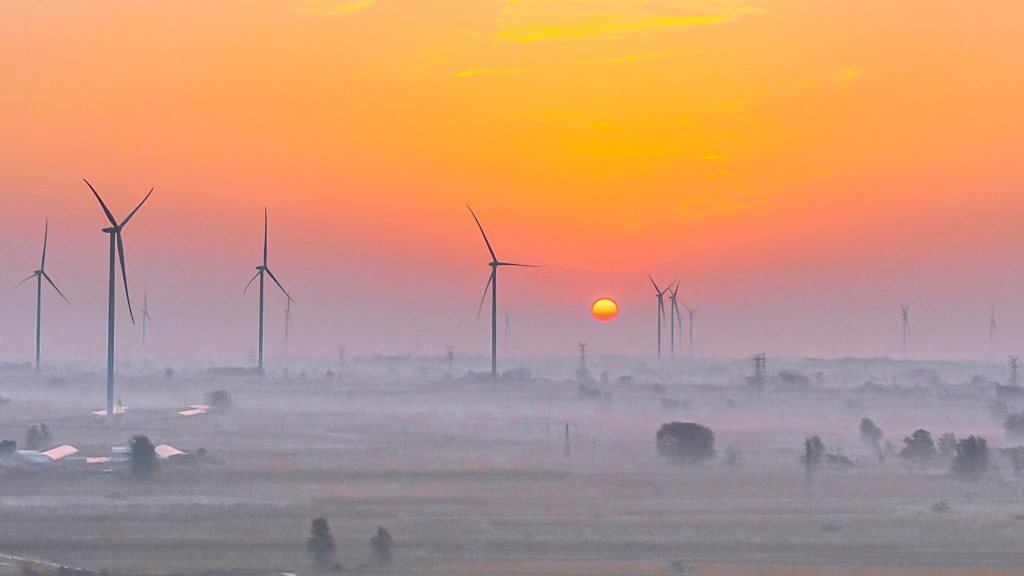

Wind-powered windmills are seen at sunrise in Suqian, Jiangsu Province, China, October 2, 2021. /Getty
A recent report (2021) from the International Renewable Energy Agency (IRENA) and the International Labor Organization (ILO) shows that in 2020, renewable energy jobs reached 12 million globally, up from 11.5 million jobs in 2019 – China alone contributed 4.7 million jobs, representing 39 percent of the entire renewable energy employment worldwide, while the U.S. provided 838,400 renewable energy jobs.
In spite of the impact of the COVID-19 pandemic, the share of renewable energy sources in the U.S.’s energy mix rose from 17 percent in 2019 to 20 percent in 2020 with solar and wind capacity growing by 15 percent over the previous year – installed capacity of wind energy increased from 9.2 gigawatts (GW) in 2019 to 14.2 GW in 2020 and that of solar PV capacity was 14.9 GW in 2020, up from 7.5 GW in 2019.
Even though the U.S. is making significant progress in growing renewable energy, the country’s combined newly installed renewable energy capacity is far less than that of China. For example, in 2020 alone, China added 136 GW to the country’s renewable energy capacity – solar power accounted for 49 GW, as solar PV installations increased by 67 percent in 2020 while wind energy also added 72.4 GW, representing close to triple what was recorded in 2019.
In fact, in offshore wind, China’s 3.1 GW of new installations is greater than the combined additions by the rest of the world. China’s phenomenal transition to clean energy is underpinned by effectively implemented pertinent government policies and measures that provide unflinching support to domestic firms, which have accounted for more than 90 percent of onshore renewable energy installations in China in over the last decade. With the Chinese government’s support to domestic firms spanning tax exemptions, export credits, low-cost credits, free land and direct cash payments, these incentives are boosting large-scale renewable energy production in local firms and facilitating economies of scale.
All these clean energy policies and measures are yielding remarkable results, so it is not a fluke that China’s total installed renewable energy capacity in 2020 was 895 GW, the largest in the world. To put this into perspective, China’s renewable energy surpasses the entire installed renewable energy capacity of all the six developed countries on the list of the world’s top nine countries with the largest installed renewable energy capacity, together with that of Brazil, which is third on the list after the United States.
China’s outstanding performance in strengthening renewable energy development contributes substantially in transforming the global production of energy into renewable power sources. This considerable contribution demonstrates the Chinese government’s full commitment to mitigate climate change.
Over the years, the Chinese government has backed its words with formidable actions by prioritizing renewable energy development in an effort to fight climate change – China’s investment in renewable energy research and development exceeds that of the U.S. and other major economies such as the United Kingdom, Japan, France, Germany, India, Brazil, etc.
In 2019, China invested $83.4 billion in clean energy research and development, while the U.S. invested $55.5 billion – China’s investment in clean energy research and development in 2019 was more than the total investment of the U.S., Japan and India, which were the three highest clean energy investors after China.
Clearly, China’s consistent enormous investment into renewable energy development is unparalleled and distinguishes the country from the U.S., which seems not to be pulling its weight to advance renewable energy in the fight against climate change.