Friday, May 15, 2026
  • Login
The Southern African Times
  • Home
  • Southern Africa
  • Business
    • African Start ups
    • African Continental Free Trade Area
  • Technology
    • Lifestyle
      • Health
      • Culture
      • Food and Drink
      • Entertainment
  • Opinion
  • Sports
  • SAT Jobs
    • Events
  • About Us
    • Advertise with Us
    • Contact Us
No Result
View All Result
  • Home
  • Southern Africa
  • Business
    • African Start ups
    • African Continental Free Trade Area
  • Technology
    • Lifestyle
      • Health
      • Culture
      • Food and Drink
      • Entertainment
  • Opinion
  • Sports
  • SAT Jobs
    • Events
  • About Us
    • Advertise with Us
    • Contact Us
No Result
View All Result
The Southern African Times
No Result
View All Result
Home Analysis

Green finance for a net-zero energy system

by SAT Reporter
August 18, 2021
in Analysis, Opinion
0
Green finance for a net-zero energy system

In the last few weeks, several regions of the world have experienced extreme climate events, which range from floods in China, Europe and India to drought and high temperatures in Serbia, which led to wildfires, even reaching the North Pole for the first time in history. Similarly, in Greece and Turkey, the impact of wildfire has been so devastating that the forest cover was lost and many people were forced to leave their home.  In North America, the situation is quite the same, as the heavy haze from raging fires has drifted across the U.S. and Canada, exacerbating air pollution.

For many decades, the world has been experiencing the never-ending ruinous impact of extreme weathers, which are mainly attributed to climate change. The recurrent heatwaves and floods, as well as rising sea levels and water scarcity has paint a vivid picture of a looming crisis for the world.

According to a report published on August 2021 from the Intergovernmental Panel on Climate Change (IPCC), each of the last four decades has been progressively warmer than the preceding decade since 1850, which confirms the impending cataclysmic impact of climate change.


ADVERTISEMENT

IPCC says that the average global surface temperature in the first two decades of the 21st century was 0.99 degrees Celsius higher than the 1850-1900 level, and more recently, from 2011 to 2020, it was 1.09 degrees Celsius warmer than the historic base period. 

The rising temperature has been accompanied with unprecedented changes. For example, between 2011 and 2020, the annual average Arctic sea ice area reached its lowest level since 1850.

Researchers have identified human-induced climate change as the main driver of climate change. The increasing contribution of human activities to greenhouse gas concentrations stimulates climate forcing, a change in the Earth’s energy balance that leads to warming or cooling effects over time.
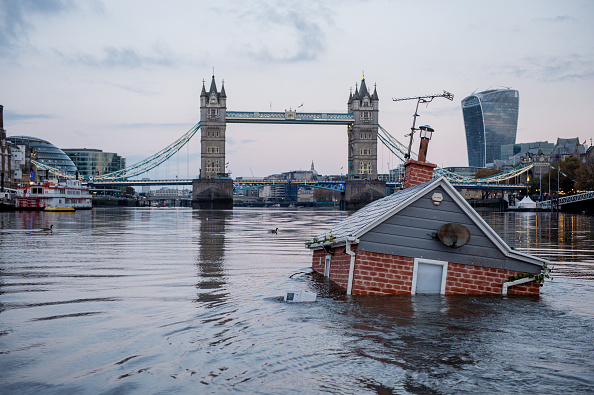
Environmental protest group Extinction Rebellion floats a replica of a British house in front of Tower Bridge on the river Thames in an action entitled ‘Our House Is Flooding,’ November 10, 2019. /Getty

To avert the climate crisis, it is essential to mitigate all human activities that foster this change. Practically, this daunting task cannot be achieved without a transition of the world’s energy sector from utilizing fossil fuel to clean energy resources.

According to the International Energy Agency, the energy sector accounts for about three-quarters of the world’s entire greenhouse gas emissions, which positions this industry as the focal point in the fight against climate change. Transforming the way energy is produced, transported and consumed is critical in reaching net-zero carbon emissions by 2050 and limiting global warming to 1.5 degrees Celsius.

Furthermore, this gargantuan transformation cannot be achieved without the support of the global financial system, which is expected to provide adequate investment in clean energy infrastructure and related research that can accelerate the invention of clean energy technologies and meet the world’s growing energy demand.

Although green banking is instrumental in developing clean energy, this financial resource has its downsides. With a large proportion of bank deposits categorized as short- and medium-term transactions, banks are usually reluctant to lend to clean energy projects, particularly those requiring long-term financing. In most cases, banks prefer lending to less risky programs, which is a major setback limiting access to green finance in many developing countries.

This finance gap for clean energy infrastructure development could be addressed by involving non-bank financial institutions, such as insurance firms and pension funds, which have the capacity to provide long-term funding.

While the integration of the services of these financial institutions to improve green finance has been anything but easy for many countries, China has been making remarkable progress in this field.

In my previous article, I discussed the impressive progress China is making in developing clean energy infrastructure in an effort to achieve carbon neutrality. For example in 2020, China installed the world’s largest capacity of renewable energy, which amounted to 895 gigawatts. In the same year, the combined renewable energy capacity of Canada, Germany, France, United States, Japan and Italy was even less than China’s total renewable energy output.  

How did China become the largest producer of renewable energy? Well, this is partly because China has the highest number of patents in renewable energy technologies and provides adequate investment via green finance.

By the end of 2020, China’s green loans amounted to $1.8 trillion, the largest in the world. In the same year, the country’s total green bonds reached $125 billion, representing the world’s second-largest. By strengthening green finance via fintech for the development of clean energy infrastructure, China is making significant progress towards achieving carbon neutrality by 2060.

Even though there is still room for improvement, China’s commitment to developing green finance and supporting the transition from fossil fuel to clean energy is worthy of emulation. Countries could support international green projects, such as the Belt and Road Initiative, to demonstrate their cooperation and dedication to achieving carbon neutrality and save the world from climate change. 

Previous Post

2022 London Marathon to remain in October

Next Post

Nando’s temporarily closes stores across UK due to supply issues

SAT Reporter

Related Posts

France Is Trying to Get New Stripes in Africa – but will it work?
Opinion

France Is Trying to Get New Stripes in Africa – but will it work?

by Development Reimagined
May 14, 2026
When AI Gets It Wrong, Humans Must Get It Right
Opinion

When AI Gets It Wrong, Humans Must Get It Right

by Dr Brighton Chireka
May 14, 2026
Can the United States Still Sanction China Into Compliance?
Opinion

Can the United States Still Sanction China Into Compliance?

by SAT Reporter
May 12, 2026
Op-Ed by President Ramaphosa | Reparations must help to address Africa’s colonial legacy
Opinion

Op-Ed by President Ramaphosa | Everyone in South Africa Must Respect and Uphold Our Laws

by SAT Reporter
May 12, 2026
Who Owns the American Story? Druski’s Viral Satire and Hollywood’s Identity Crisis
Opinion

Who Owns the American Story? Druski’s Viral Satire and Hollywood’s Identity Crisis

by Michelle Mungeni
May 12, 2026
Next Post
Nando’s temporarily closes stores across UK due to supply issues

Nando’s temporarily closes stores across UK due to supply issues

Browse by Category

  • Africa AI
  • African Continental Free Trade Area
  • African Debt
  • African Start ups
  • Agriculture
  • AI Africa
  • Algeria
  • All News
  • Analysis
  • Angola
  • Arts / Culture
  • Asia
  • Botswana
  • BOTSWANA
  • BREAKING NEWS
  • BRICS
  • Burkina Faso
  • Burundi
  • Business
  • Business
  • Business Wire
  • Cameroon
  • Central Africa
  • Chad
  • China
  • Climate Change
  • Climate Changev
  • Community
  • Congo Republic
  • Conservation
  • Côte d’Ivoire
  • COVID 19
  • CRYPTOCURRENCY
  • Culture
  • Democratic Republic of Congo
  • Diplomacy
  • Eastern Africa
  • Economic Development
  • Economy
  • Education
  • Egypt
  • Elections 2024
  • Energy
  • Entertainment
  • Environment
  • Eritrea
  • Ethiopia
  • Europe
  • Fashion
  • Feature
  • Finance
  • Financial Inclusion
  • Food
  • Food and Drink
  • Foods
  • GABON
  • Ghana
  • Global
  • Global Africa
  • Guinea
  • Health
  • Immigration
  • in Southern Africa
  • International news
  • International Relations
  • Investment
  • Ivory Coast
  • Just In
  • Kenya
  • Lesotho
  • Libya
  • Life Style
  • Lifestyle
  • Literature
  • Malawi
  • Malawi
  • Mali
  • Markets
  • Mauritius
  • Middle East
  • Mining in Africa
  • Morocco
  • Mozambique
  • Namibia
  • niger
  • Niger
  • Nigeria
  • North Africa
  • North-Eastern Africa
  • Obituaries
  • Obituary
  • Opinion
  • PARTNER CONTENT
  • Politics
  • Property
  • Racism
  • Rwanda
  • Rwanda
  • SADC
  • SAT Interviews
  • SAT Investigation
  • SAT Jobs
  • Saudi Arabia
  • Senegal
  • Seychelles
  • Somaliland
  • South Africa
  • South Sudan
  • Sports
  • Startup Africa
  • STOCK EXCHANGE
  • Sudan
  • Sustainability
  • Sustainablity
  • Tanzania
  • Technology
  • Telecommunications
  • The Editorial Board
  • The Power Of She
  • Togo
  • Trade
  • Travel
  • Travel
  • Tunisia
  • Uganda
  • Uncategorized
  • Wealth
  • West Africa
  • World
  • World
  • ZAMBIA
  • Zambia
  • ZIMBABWE
  • Zimbabwe

Browse by Tags

#NewsUpdate #SouthAfrica #SouthernAfricanTimes #TheSouthernAfricanTimes AfCFTA africa African Continental Free Trade Area African development African Development Bank African economies African economy African Union Agriculture Angola Botswana Business China Climate change Cyril Ramaphosa Economic Development economic growth energy transition governance industrialisation Inflation Infrastructure Infrastructure Development International relations Investment Kenya Mozambique Namibia news Nigeria Regional Integration renewable energy Rwanda SADC South Africa Southern Africa sustainable development Tanzania United States Zambia Zimbabwe
ADVERTISEMENT

WHO WE ARE

The Southern African Times is a regional bloc digital newspaper that covers Southern African and world news. The paper also gives a nuanced analysis on news and covers a wide range of reporting which include sports, entertainment, foreign affairs, arts and culture.

Welcome Back!

Login to your account below

Forgotten Password?

Retrieve your password

Please enter your username or email address to reset your password.

Log In

  • Home
  • Southern Africa
  • Business
    • African Start ups
    • African Continental Free Trade Area
  • Technology
    • Lifestyle
      • Health
      • Culture
      • Food and Drink
      • Entertainment
  • Opinion
  • Sports
  • SAT Jobs
    • Events
  • About Us
    • Advertise with Us
    • Contact Us
Are you sure want to unlock this post?
Unlock left : 0
Are you sure want to cancel subscription?